Sizing up seller, catalogue and agent before an object order
Signals worth looking for before you pay, from Kakobuy's own advice and from reading many object listings.
Seller signals on an object listing
Kakobuy's own advice on sellers is in clause 5 of help 48: choose "the well-reputed store which has more than three hearts and has paid for the Taobao guarantee." Hearts are the lowest tier of Taobao's store rating; a store past three hearts has completed a fair number of sales. Kakobuy warns that with low-credit stores you may face "false delivery, not delivery, no after-sale service, and no rights protection", and that the loss is yours.
For object listings we add a few signals of our own:
- Photos of the real thing. The X60 game player listing shows two units on a cardboard sheet next to their box. That is the seller's own stock, not a press image.
- A feature line that matches the title. When the photo says 声光 and the title says "Sound and Light", the listing is consistent.
- Printed size or weight. Sellers who print 447 g know their product.
- Versions named clearly. "With remote" and "without remote" as separate choices, not a single photo and a vague price range.
- No character or brand name doing the selling. For the reasons on the figures page.

Holding Spreadsheet sites to account, including kakobuyproducts.com
Spreadsheet sites multiply fast, and plenty of them read alike. A few checks separate the maintained ones from the abandoned:
- Dates on prices. A price with no date is a guess. Every price on this site carries November 10, 2026.
- Links that still work. Click through five links chosen at random. When two of them fail, the site has been left alone.
- Rules with sources. When a site says an agent does something, it should link to where the agent says so.
- Honest gaps. A site that tells you what it left out, such as our thin gadget shelf, is easier to trust than one that looks complete.
- A named operator and a way to reach them. See our about page.
- Clear about money. If the site earns from a sign-up link, it should say so where you can see it.
Apply the list to us as well. Should a card or a rule here have gone stale, the about page has the address for corrections.

Look into the agent before money goes on the account
Choosing an agent for object orders starts with what you can check from outside, before you put money on the account. For Kakobuy, on its own pages:
- Who runs it. The contact page gives a US company in Denver and a UK company in Beckenham, with the UK registration number printed. The UK number can be looked up in the public company register.
- How to reach a person. Live chat 9am to 6:30pm (BST on the contact page), Monday to Friday; [email protected] by email.
- Where refunds go. Kakobuy's refund terms say recharges are returned to the original payment method and the handling fee is the user's.
- What it refuses. Help 125 states the anti-counterfeiting policy and what happens to accounts that break it.
- What it checks. Help 89, 95 and 48, as covered across this site.
Then put in a small first order, one object with a working part and something simple, and see the whole route before a large one.
Small slips that cost object buyers
Most problems with object orders come from a handful of small slips rather than bad sellers:
- Choosing the lowest-priced version without reading it. The first price on a listing is often the bare item, without the remote, the box or the stand.
- Adding one gadget to a clothing parcel. One battery can limit the line choice for the whole box.
- Opening the seal to look. For figures and models it can end your return option.
- Leaving photos unread. The 120-hour window runs from stock-in, not from when you log in.
- Not ticking parcel photos. They are free, and the only view of how a boxed model was packed.
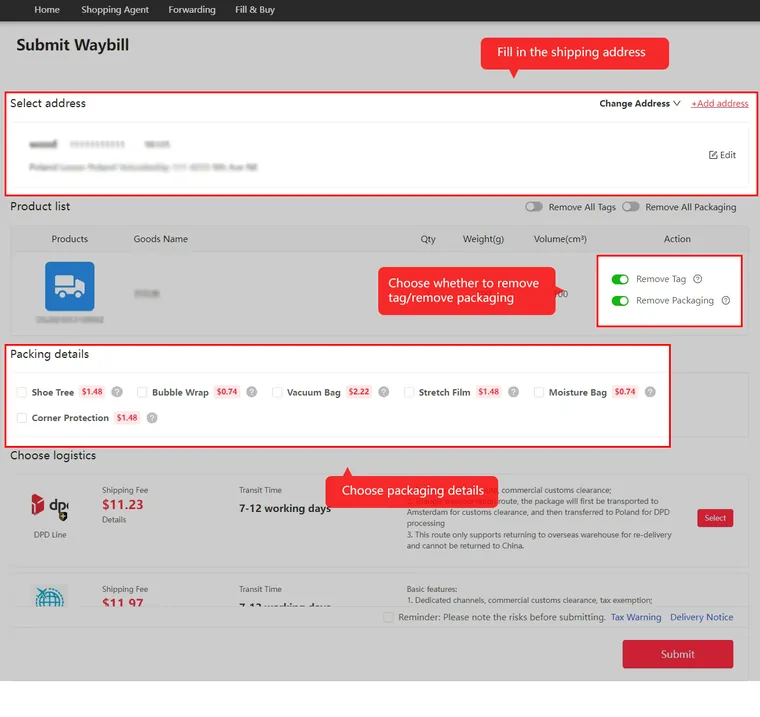
- Ignoring the packing options. The waybill page offers packing details such as bubble wrap and corner protection; for a boxed model they are worth reading.
Kakobuy's tutorial screenshot below shows the waybill page with those packing choices.