The cost of an object order through Kakobuy, and its route out of China
The bill in parts, the currency question, and the line choice that batteries and heavy boxes force on you.
A model car's bill taken apart
Help 74 writes the bill as an equation: "Total cost = commodity cost + international freight + packaging fee + value-added service fee (optional if necessary)". The first term means what the seller asks plus their postage to the warehouse.
Take the Newao McLaren Senna from the finder, listed at CN¥71.8 on November 10, 2026. Your first payment is that price plus whatever domestic shipping the listing shows. Help 75 charges that domestic postage once when a single purchase order holds several items from one seller. Your second payment, at the waybill, is the line fee for the whole parcel plus the per-parcel charges.
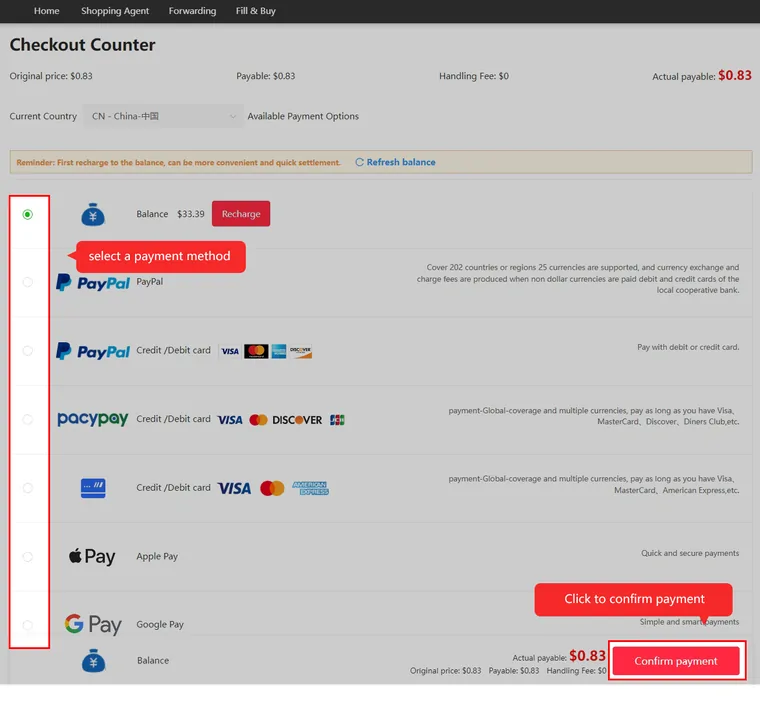
Two per-parcel charges of the same size appear in two different articles. Help 74 adds ¥8 per parcel and calls it a "Packaging consumables fee". Help 63 says "Customs declaration cost for a parcel is generally RMB 8.00 (Depending on the shipping method)." Both stay separate here because the two articles keep them apart; whether both appear on your bill is something your parcel checkout shows. Help 63 also lists no agent service fee. PayPal top-ups carry three handling-fee wordings from Kakobuy itself: help 64 and help 99 say 3.5%+US$0.3; the text of help 65 says 2.9%+ US$0.3; and the checkout screenshot in that article works it out as payment × 0.03 + 0.01. Kakobuy has not reconciled them, so neither do we.
Why every price here stays in yuan
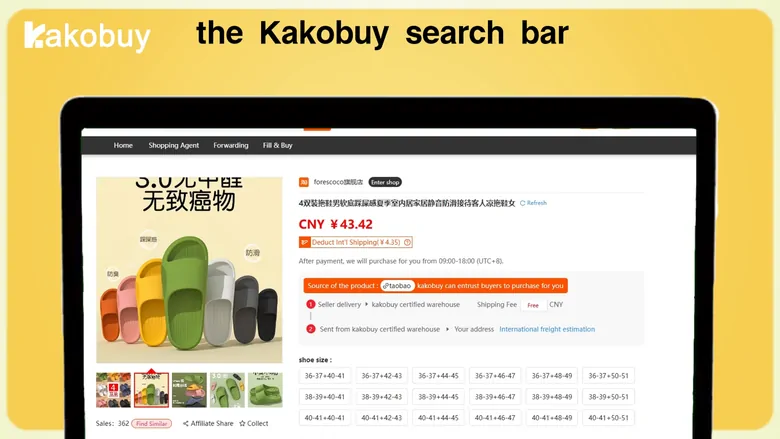
Every listing on the catalogue and on Kakobuy starts in Chinese yuan, written CNY or ¥. Kakobuy can show prices in twelve currencies, from US dollars and euros to Norwegian krone, and the exchange rate it applies to yuan is its own. The rate it uses is not the one on a currency site, and it moves.
That is why the finder cards and these pages give yuan and a date. When you need your own currency, read it on Kakobuy at checkout, on the day. A card saying CN¥88 for the Countach model will still mean CN¥88 next month if the seller has not changed it; a dollar figure would not.
The frame below shows how Kakobuy's own product page puts it: the yuan price in bold, "Source of the product" under it, and the platform name. The switch for language and currency sits in the page header, set to English and USD by default.
Battery in the box: which Kakobuy lines stay open
At the waybill step Kakobuy lists the lines available for your address and parcel. Each card shows a fee, a transit time and a "Line characteristics" note. For object parcels the note matters more than the fee. On the United States estimator on November 10, 2026:
- Lines that say they take batteries: two "-electrified" lines, the USPS Tax-Free Line (Battery Accepted) and, for cosmetics, the Cosmetics Air Express(Battery,Liquid).
- Lines that say they do not: EUB (Batteries and Perfume Not Allowed), UPS Duty-Free (No Batteries), and the EMS cards, whose notes refuse anything "charged".
- One card that says both: the Battery Accepted USPS line also lists "electrified products" as prohibited.
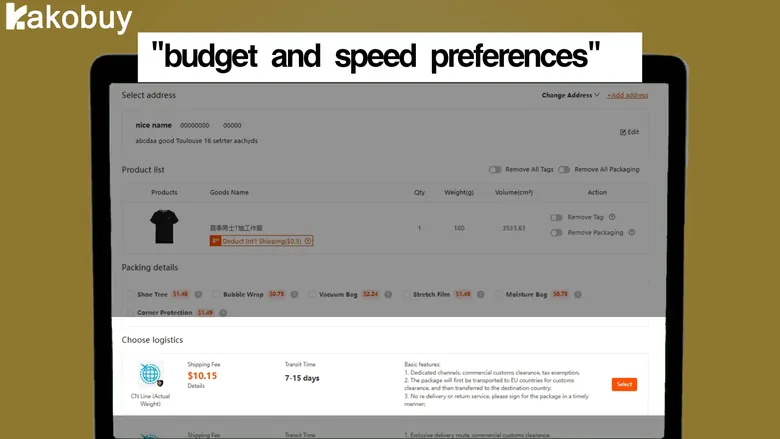
Choose for the most sensitive item in the parcel. If one remote-control car pushes a whole clothing order onto a slower or dearer line, ship it on its own. Kako Insurance, offered at the waybill per help 123, covers delay, customs holds and loss or damage on the terms of each line; read the line's terms before relying on it for a gadget.
The frame below is Kakobuy's video at the waybill step: packing options above, "Choose logistics" below.
Die-cast cars are heavy: grams, carton size and the 10 kg warning
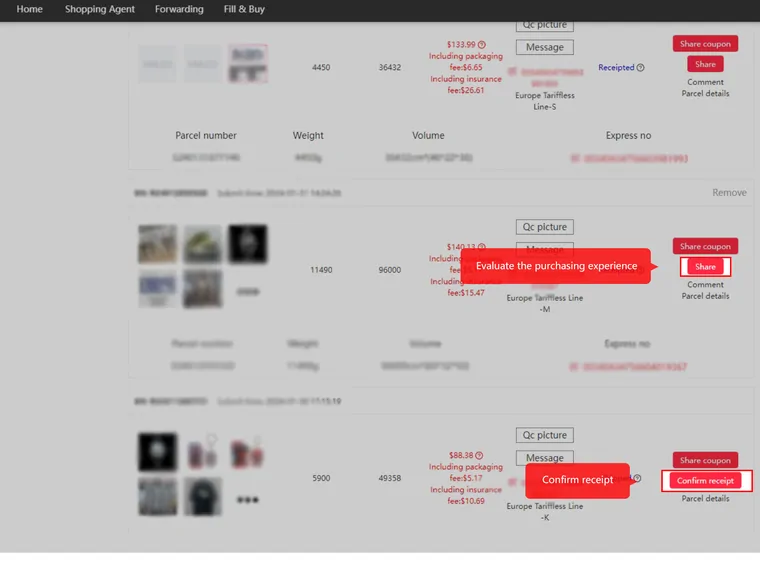
Objects are weighed after packing. In Kakobuy's tutorial screenshot, the parcel list gives each parcel's grams beside its cubic centimetres. Some lines charge by actual weight only up to a size limit; the EUB card on November 10, 2026 said a single side under 60 cm is charged on actual weight, and that line's actual weight limit was 2 kg.
For model cars and boxed figures, the box is often most of the volume. Help 21 puts it this way: "For parcels that are over 10KG, it will be considered as a commercial parcel more likely," and it adds that "too many same items" in a parcel can tip it the same way. Spread a large model order across parcels and vary what goes in each.
When the listing prints weight, as the 1:9 motorcycle does at 447 g, add it up before you choose a line. When it does not, ask the seller for the boxed weight before you order.
Parking objects in the warehouse while other sellers catch up
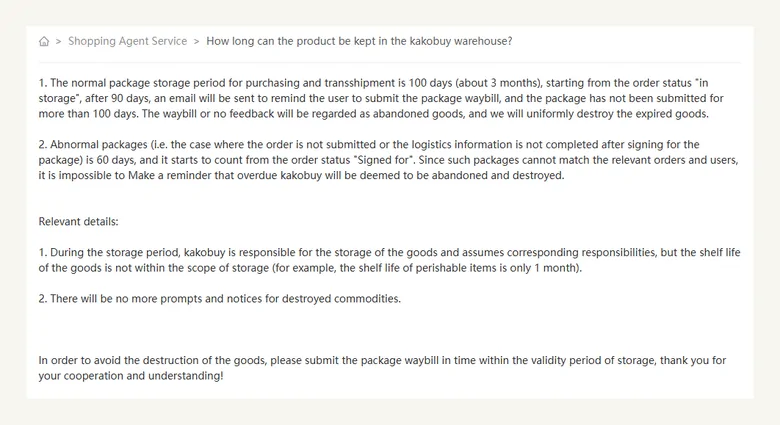
Objects often come from several sellers, and the slowest one sets the shipping date. Help 1 keeps normal items free for 100 days and emails a reminder on day 90; after that the item counts as abandoned. The clock starts at "in storage" according to help 1, and at "Ready for Shipping" according to help 120. We give both because Kakobuy does, and suggest counting from the earlier status.
Help 1 also sets 60 days, counted from "Signed for", for abnormal packages: parcels that land with no order or account to tie them to. Kakobuy notes that nobody can be reminded about those, since the owner is unknown. Anything you send into the warehouse yourself needs to be matchable on arrival.